Our Targeted SEO Strategy Improved Location Page Visibility in a Competitive Property Market
For commercial property websites, appearing prominently in Google search results is an important source of enquiries from businesses looking for office, retail and industrial premises. Searches such as “office space to rent Foreshore“or “offices to let Claremont” and “warehouse to rent Epping” indicate that the person searching may already be considering a property requirement. Unlike general property research queries, these searches often come from business owners, facilities managers, property directors and corporate occupiers actively comparing locations and available premises.
For commercial real estate businesses, ranking for these searches can generate relevant website traffic and potential leasing enquiries without relying entirely on paid advertising. At Web Space Design & Marketing, our approach to search engine optimisation involves identifying the pages with the greatest potential to attract qualified visitors, reviewing their existing search performance and implementing improvements that support long-term organic visibility. This case study looks at the optimisation of commercial property location pages, using our clients Cape Town office property website as a practical example.
The Challenge: Competing for Location-Based Property Searches
Commercial property websites often have hundreds or thousands of individual listings spread across multiple cities, suburbs and commercial districts. These listings contain valuable information about specific properties, but they create an SEO challenge. A commercial property portal might have several individual office listings in the Cape Town CBD, each mentioning similar keywords, buildings, street names and location information.
At the same time, the website will generally have a central location page intended to rank for broader searches such as “office space to rent Cape Town CBD”. Without a clear content structure, Google may struggle to determine which page is the most appropriate result for the search.
Individual property listings can compete with their own location pages, while location pages with limited supporting content may struggle against more established property portals.
Our optimisation work focused on several recurring issues:
Location pages with insufficient information about the commercial property market.
Individual property listings competing for broader location-based search terms.
Page titles and descriptions that could be better aligned with search intent.
Limited differentiation between nearby commercial districts.
Internal linking that did not consistently reinforce the priority location pages.
Property descriptions that did not provide sufficient local context.
Opportunities to improve how relevant content appears in search results.
The objective was to strengthen the location pages as the primary destination for commercial property searches while allowing individual buildings and property listings to continue targeting more specific queries.
1. Analysing Existing Rankings Using Google Search Console
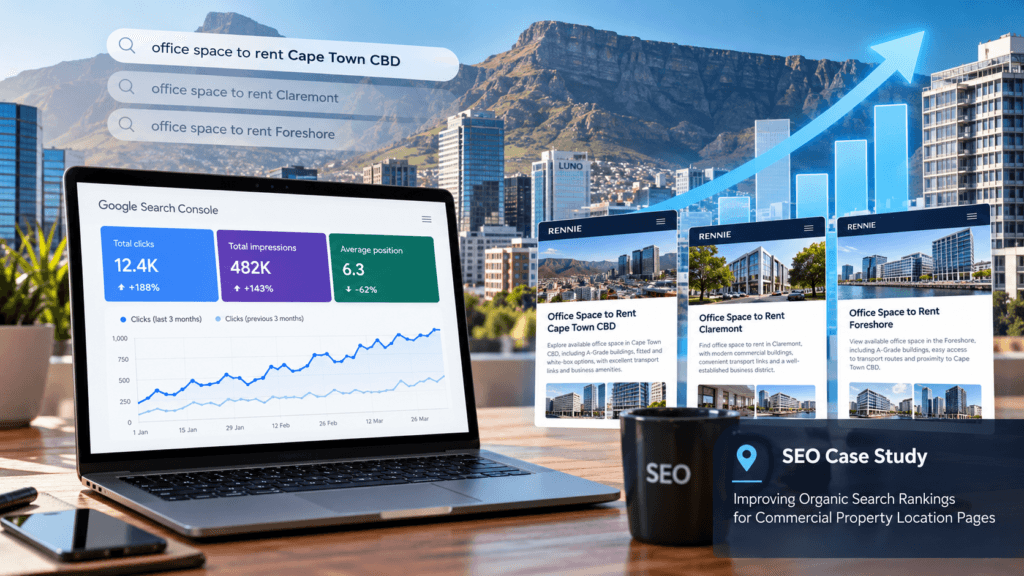
The first stage involved assessing the website’s existing organic search performance. Google Search Console provides information about the search queries generating impressions and clicks, along with average ranking positions and click-through rates. Rather than concentrating exclusively on total website traffic, we examined performance at the individual landing-page level.
This helped identify location pages that were already performing well, alongside pages that were receiving search impressions but had opportunities to improve their visibility. For example, the Cape Town CBD office rental page had already established strong organic visibility, with average rankings generally around positions 1–3 for its priority search terms during the review period. This demonstrated that the website could compete effectively for valuable commercial property searches. However, other locations, including the Foreshore, presented opportunities for improvement. Our assessment focused on identifying the differences between these pages, including content relevance, keyword targeting, internal links and competition from other pages within the website.
The important principle was to optimise each location according to its existing performance rather than applying the same changes across every page.
Pages already ranking prominently required careful maintenance, while underperforming pages needed more substantial content and structural improvements.
2. Improving Location Page Content and Search Relevance
One of the most important aspects of the project involved reviewing the content on individual location pages. A commercial property location page needs to provide more than a list of available offices or warehouses. It should give prospective tenants useful information about the area, the types of premises available, rental considerations, prominent buildings and access to surrounding business infrastructure. We reviewed the location pages to establish whether their content adequately addressed the questions businesses might ask when considering a particular commercial district.
For office locations, this included:
The types of office buildings available.
Premium, A-Grade and B-Grade office accommodation.
Typical rental ranges and differences between building grades.
Fitted, partially fitted and white-box office options.
Parking availability and associated costs.
Transport connections and access routes.
Established commercial buildings and business precincts.
The types of businesses typically operating in the area.
The objective was to make each location page a more useful resource for prospective tenants without creating unnecessary duplication across the website.
Example: Cape Town CBD Office Space
The Cape Town CBD location page was developed around the office rental market across established commercial precincts, including Long Street, Bree Street, Loop Street, Lower Long Street and St Georges Mall.
Prominent commercial buildings such as The Box, 35 Lower Long Street, One Thibault, The Rubik and 11 Adderley Street provide practical context about the accommodation available in the city centre.
Rather than using generic descriptions of the Cape Town CBD, the content focuses on the factors prospective tenants are likely to consider when comparing commercial premises.
These include office size, rental rates, building grade, existing office configurations and access to transport and business services.
The resulting page provides a direct connection between the location-based search and the available office inventory.
View the example: Office Space to Rent in Cape Town CBD
3. Reducing Keyword Cannibalisation Between Location Pages and Property Listings
A common challenge for property websites is keyword cannibalisation. This occurs when multiple pages compete for similar search queries, making it difficult to establish a clear primary landing page. Commercial property portals are particularly susceptible because individual listings frequently repeat the suburb, property type and rental terminology used on the main location pages. For example, an individual office building in the Foreshore might rank for “office space to rent Foreshore”, even though the broader location page is the more suitable destination for someone comparing several buildings.
The building page should ideally capture searches relating to that specific building, while the location page should serve people searching for offices across the wider commercial district. Our approach involved reviewing the relationship between location pages, building profiles and individual property descriptions. We then focused on strengthening the distinction between their content.
Read more on our Website Design Services
Location pages were positioned around broader commercial property searches, such as office space to rent in a particular suburb.
Building profiles were focused on the building’s name, facilities, specifications and location.
Individual property listings were written around the particular premises, floor area, internal configuration and availability.
This approach helps establish a more logical website hierarchy. It also improves the experience for visitors by directing them to pages that better match what they are searching for. Keyword cannibalisation is not always resolved by rewriting content alone. It requires ongoing monitoring of which pages Google selects for different search queries.
4. Improving Property Listings to Support Location Page SEO
Individual commercial property listings provide an opportunity to reinforce the relevance of their associated location pages. A well-written listing should clearly identify the type of premises, the building and the location while providing accurate information about the property’s specifications.
For example, a listing for a 450 m² office at Stadium on Main in Claremont should communicate the property type, building name and suburb early in the description.
A useful opening might read:
“450 m² office space to rent at Stadium on Main in Claremont, offering an open-plan layout with access to established retail facilities, public transport and the surrounding Southern Suburbs business district.”
This is more informative than a generic description that begins with promotional language or unrelated building features. The approach is particularly relevant where property portals automatically display the opening section of individual listings on their parent location pages. In these cases, the opening paragraphs contribute to the overall quality and relevance of the information visible on the location page. We focused on writing property descriptions that support the individual listing while maintaining consistency with the wider location’s search intent.
5. Strengthening Internal Linking and Website Hierarchy
Internal linking is an important component of location page optimisation. Commercial property websites often contain different types of content relating to the same geographic area, including rental listings, building profiles, suburb guide Claremont and market information.
These pages should have clearly defined roles and link to one another where relevant. For example, a detailed Claremont area profile can provide information about the business district, surrounding amenities, transport connections and prominent commercial buildings. The main location page, meanwhile, should focus on helping visitors find available office premises.
Where the website structure permits it, the area profile can direct readers to the relevant rental location page.
This gives visitors a practical next step while helping search engines identify the relationship between the two pages.
Example: Claremont Office Property
The Claremont office rental location page provides access to available office premises within this established Southern Suburbs business district. The page references buildings such as Sunclare, Stadium on Main, The Citadel and other commercial properties in the surrounding area. Supporting area content provides additional information about the Claremont commercial market, its location and the infrastructure that makes it suitable for professional services businesses and corporate occupiers.
By separating the role of the rental page from the broader area information, the website can address different search intentions without relying on multiple pages to perform exactly the same function.
6. Optimising Metadata, Headings and Page Content
On-page SEO remains an important part of improving the visibility of location-based landing pages.
Need an Audit, let us review your site and get a free website audit.
The optimisation process included reviewing page titles, meta descriptions, headings and content placement. The priority was to ensure that each page clearly communicated its primary subject. For example, a page targeting “office space to rent Claremont” should have an SEO title and primary heading that accurately reflect the commercial office rental content. The meta description should support that search intent while giving users a useful summary of the page.
We also considered how location names, rental terminology and related subjects were incorporated into the page content. This did not involve repeating the same keyword unnecessarily. Instead, the focus was on using natural commercial property terminology and including information relevant to the geographic area.
Where content management system restrictions limited changes to headings or page structure, we prioritised the elements that could be edited, including descriptions, introductory text and supporting area information. This practical approach allowed optimisation work to continue without requiring a complete redevelopment of the property website.
7. Creating More Useful Content Around Commercial Locations
A location page can benefit from supporting content that addresses subjects beyond the immediate property listings. For commercial office locations, this might include information about different business districts, the types of tenants operating in those areas and the factors influencing office accommodation decisions. For example, prospective occupiers comparing the Cape Town CBD with the Foreshore may be interested in differences in office building grades, access to public transport, parking availability and proximity to major business facilities. Similarly, a business considering Claremont might want to know about office buildings near Cavendish Square, Main Road, Dreyer Street or the surrounding Southern Suburbs.
Including relevant local information helps create a more complete resource for potential tenants. It also provides opportunities for supporting articles and area profiles to link readers to the appropriate rental landing pages. The aim is to develop a website structure where each piece of content serves a specific purpose and contributes to the broader subject.
8. Monitoring Organic Search Performance
SEO optimisation does not end once new content has been published. Search rankings change as competitors update their websites, new properties become available and Google reassesses the relevance of different pages. We use Google Search Console to review how priority pages perform over time.
The main measurements include:
Organic search impressions.
Organic clicks.
Average ranking position for relevant queries.
Click-through rates.
Changes in the queries associated with individual landing pages.
Whether the intended location page is appearing instead of a competing building or listing page.
We also assess whether the page is attracting searches that reflect the commercial objectives of the business. For example, attracting visitors searching for available office space is generally more valuable to a property brokerage than increasing traffic from unrelated informational searches. This allows optimisation priorities to be adjusted based on the performance of individual locations.
9. Results and Progress
The commercial property location page optimisation work has produced useful performance insights and established a clearer strategy for improving organic visibility across the website. The Cape Town CBD office rental page has demonstrated strong organic performance, with average positions around 1–3 for priority searches during the assessment period. This provides a useful benchmark for how a well-established location page can perform in a competitive commercial property market. Other locations, including the Foreshore, remain part of an ongoing optimisation programme. These pages are being reviewed and improved through more focused content, better differentiation between location and building pages, and adjustments to internal linking.
What the Project Has Established
1. Strong-performing location pages need to be protected.
A page already ranking prominently should not be subjected to unnecessary content or structural changes without assessing the potential impact.
2. Underperforming locations need individual attention.
Different commercial districts have different competitors, property inventories and search patterns. A single content template will not address every location equally effectively.
3. Property listings can support wider SEO objectives.
Accurate, location-specific listing descriptions improve the usefulness and consistency of the information presented across the website.
4. Content hierarchy matters.
The distinction between location pages, area profiles, building pages and individual listings helps reduce unnecessary overlap.
5. SEO is an ongoing process.
Monitoring rankings, identifying cannibalisation and refining content are continuing activities rather than once-off changes. The longer-term objective is to increase qualified organic traffic to priority location pages and generate more commercial property enquiries. Further performance comparisons will be necessary to quantify the effect of individual changes on rankings, traffic and lead generation.
10. What Other Businesses Can Learn from This SEO Strategy
Although this case study focuses on commercial property, the principles apply to many businesses operating across multiple geographic locations. Companies providing legal services, healthcare, construction, professional services or other location-dependent offerings can face similar SEO challenges. A business might have separate pages for Cape Town, Claremont, Durban and Johannesburg, each targeting the same core service in a different market. For these pages to compete effectively in organic search, they need more than a suburb name inserted into otherwise identical content.
They should provide relevant information about the service, the location and the needs of potential customers in that market. The relationship between local landing pages, service pages and supporting informational content should also be clearly established. Businesses that manage these elements consistently are better positioned to build relevant organic search visibility over time.
11. SEO Services for Businesses Targeting Multiple Locations
At Web Space Design & Marketing, we work with businesses looking to improve their organic search presence through practical SEO strategies. Our services cover technical SEO, keyword research, on-page optimisation, content development, internal linking and performance monitoring. For businesses with multiple service areas or location pages, we focus on establishing a clear website structure and ensuring that each priority page serves a defined search intention.
This includes identifying underperforming pages, reviewing competitor activity, correcting overlapping content and developing location-specific information that supports relevant searches. Whether your business operates in one city or across several regions, a structured SEO approach can help improve search visibility and create more opportunities for qualified enquiries.
Contact Web Space Design & Marketing to discuss an SEO audit or a location-based search optimisation strategy for your website. This case study was written by Lindi Hellyer using her 10 years of SEO experience to help grow her clients digital presence.
Web Space Design was built on a simple belief that all businesses deserve the same quality of digital strategy that large corporates take for granted. We are a Cape Town digital marketing agency specialising in web design, SEO, and search visibility, including the emerging discipline of Generative Engine Optimisation (GEO), which helps businesses appear in Google’s AI-generated search results.